
A braided sock rug costs nothing if you already have the socks, takes an afternoon to finish at two feet across, and needs no sewing machine or frame.
Most people quit halfway through because they run out of fabric or the coil starts to buckle.
You need 15 to 20 pairs of crew or athletic socks to reach that size, and the rug stays flat only if you stitch each new spiral pass to the one before it without pulling the braid tight.
Collect Old Socks and Materials
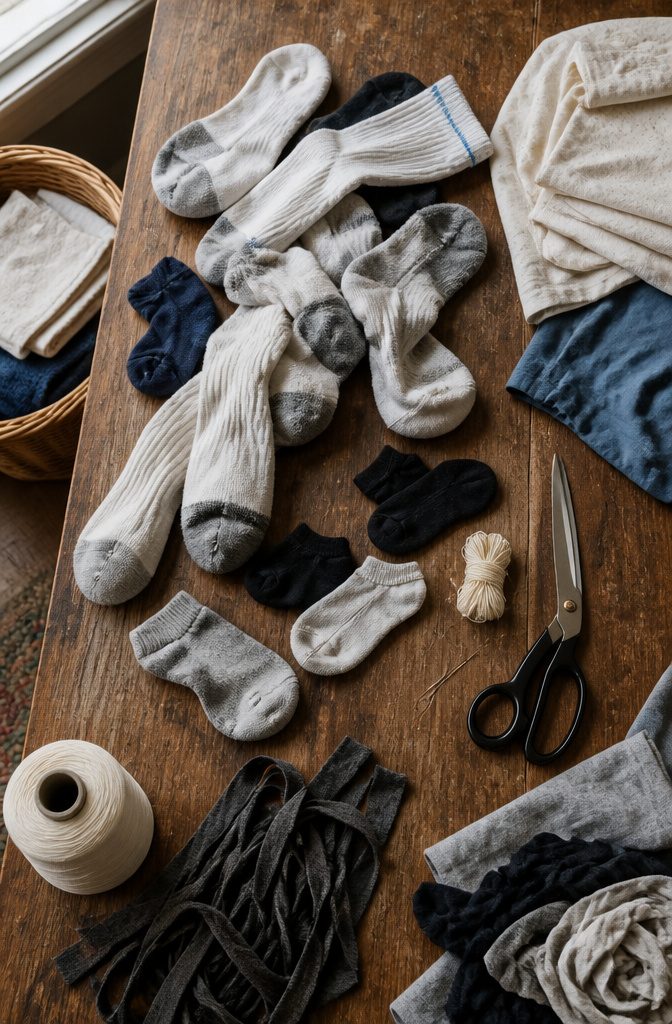
The socks you already own work better for this than anything you would buy new.
Cotton crew socks and athletic socks have enough fabric to cut into strips, and mixing colors gives the finished rug more texture than a single shade.
I look for socks with worn heels or lost partners, since those sit in the drawer anyway. Thin dress socks and ankle cuts are too small to yield much usable material; they add filler but not much surface.
For a small rug around two feet across, you need roughly 15 to 20 pairs of socks, depending on how wide you cut your strips and how tightly you braid.
Larger socks stretch the count further; kids’ socks mean you need more. Sheets or old T-shirts fill in if you run short on socks, and the difference does not show once everything is braided together.
Beyond the socks, you need sharp fabric scissors, a large needle, and strong thread or warp string to stitch the coils in place as you build the rug.
Prepare the Socks
Prepare the Socks
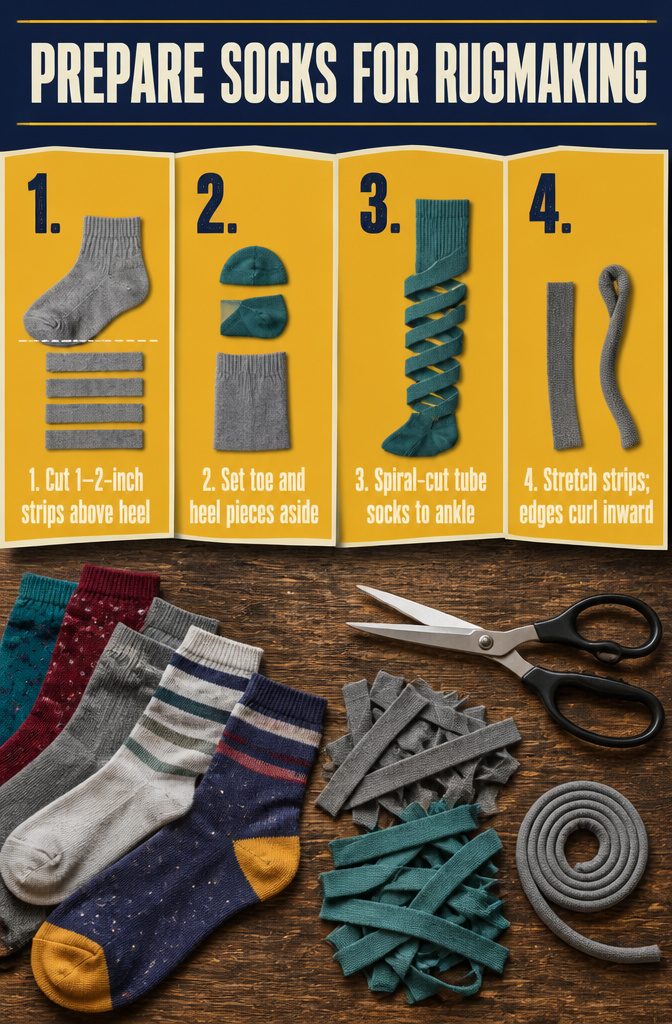
- Cut each sock into strips about 1–2 inches wide, starting just above the heel. Socks are thicker than t-shirt fabric, so keeping the strips on the narrower side makes them easier to braid or loop without getting bulky. I cut straight across with fabric scissors, though a rotary cutter works if you’re doing a lot at once.
- Discard the toe and heel sections or set them aside for stuffing. The tube part of the sock gives you the longest usable length, and you want pieces that lie flat when you pull them taut.
- For tube socks or knee-highs, you can spiral-cut them into one continuous strip rather than chopping them into rings. Start at the top and cut in a slow spiral down to the ankle. This gives you longer working lengths and fewer joins later.
- Stretch each strip gently after cutting. The edges will curl inward and the fabric relaxes into a rounder, softer cord that hides the raw edge.
Start the Base
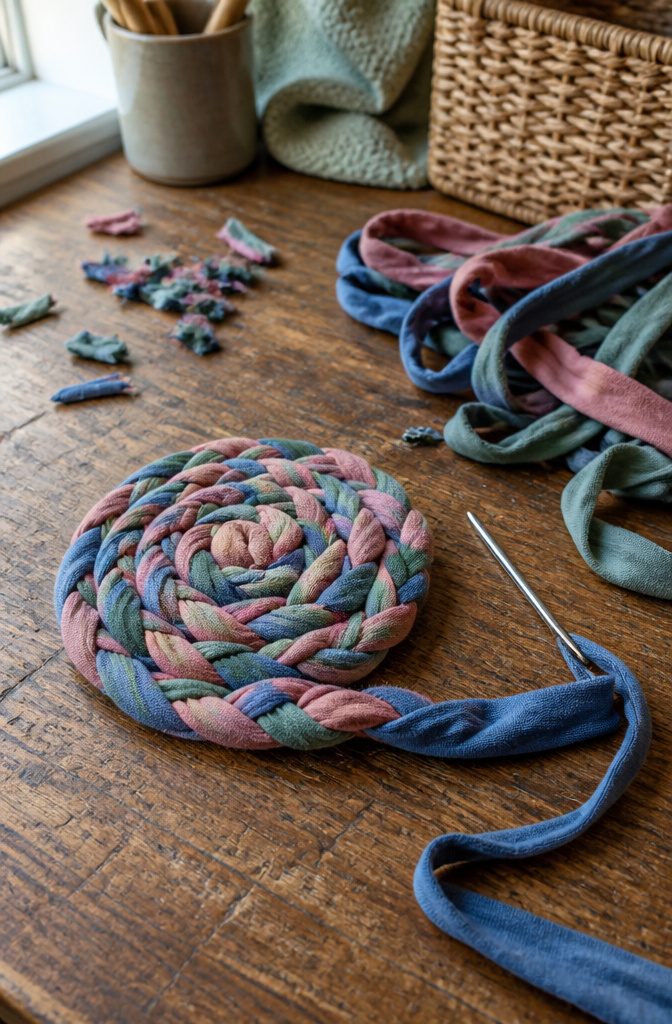
The braid becomes the rug once you start coiling it flat.
Take three sock strips and knot or sew the ends together, then braid a couple of inches. The length depends on the shape you want.
A longer initial braid makes an oval center; a shorter one gives you a circle. I aim for about two inches when I want something close to round.
Lay the braid flat on your work surface.
This is where the structure begins. All three strands are going to curve around and attach to the braid you just made.
The inside strand loops through one of the gaps in the existing braid, then you continue the braid as normal. It feels awkward the first time, but the motion settles in quickly.
If your braid is tight or the sock fabric is thick, thread a large needle onto the inside strand.
The needle makes it easier to push through the loops without wrestling with the fabric. Keep braiding, and every time the inside strand comes around, loop it through the edge of the previous row.
Build the Rug Body
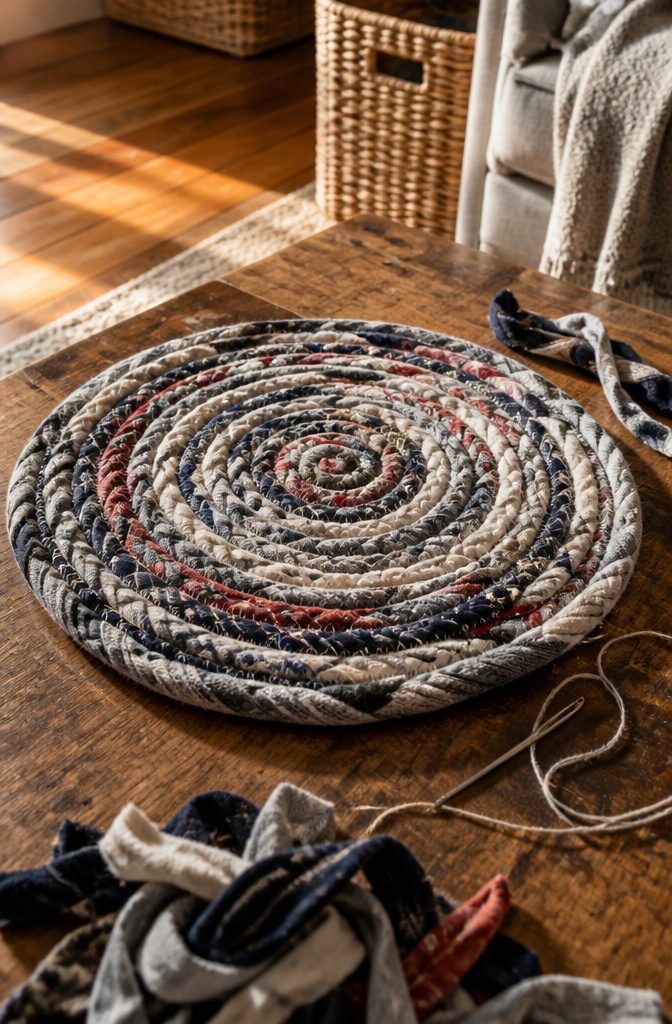
Once your braid reaches about eight inches, you can start building the rug outward by coiling the braid and stitching it to itself as you go.
Hold the starting end flat and begin winding the braid around it in a tight spiral, keeping the surface flat so the rug lies evenly on the floor.
Every few inches, pause and use a large needle threaded with strong string to stitch through the edge of the new braid and into the loop directly beside it.
The stitches do not need to show; you are just anchoring each pass to the one before it so the coil holds together under foot traffic.
As the rug grows, you will run out of sock fabric. When that happens, add a new strip by knotting it to the end of one strand in your braid, then keep braiding and coiling.
The joins disappear into the structure, so mismatched colors or thicknesses do not ruin the look. Keep checking that the rug stays flat; if it starts to buckle or cup, you are pulling the braid too tight as you coil.
Finish and Secure the Edge
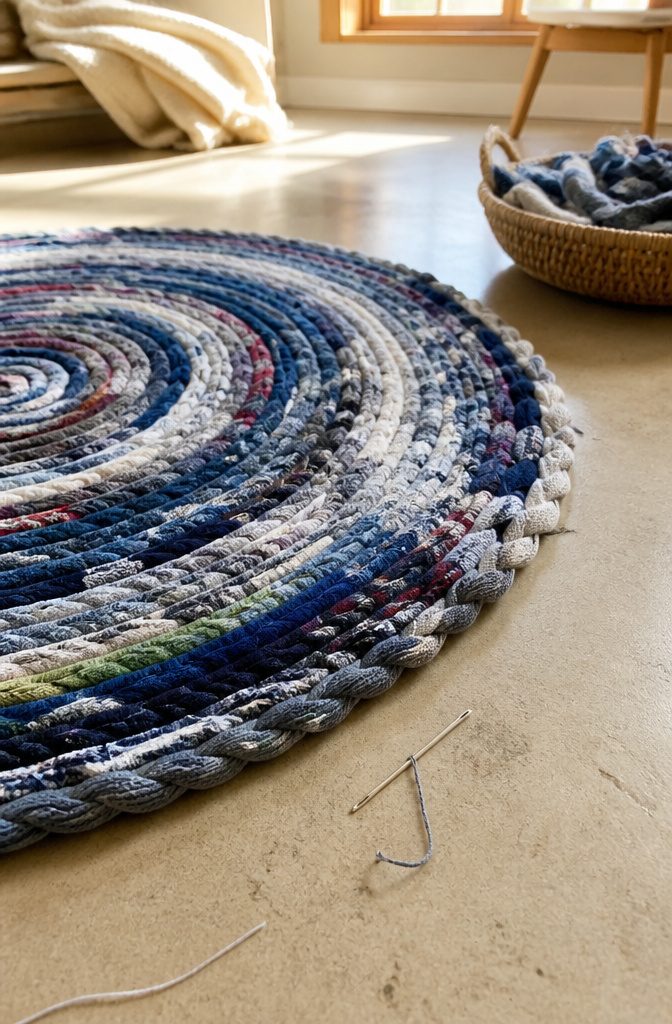
When the last strip reaches the middle of the rug and the spiral feels complete, taper the final three or four sock strips to points so they fade out instead of ending blunt.
I cut each one so it narrows gradually over the last few inches, trimming all three ends to land at roughly the same spot. That keeps the finish from bulking up or looking like it just stopped.
Thread a needle with strong thread in a color that disappears into the sock fabric, then stitch that tapered section flat against the nearest row of the spiral.
A few tight stitches through the base layer lock it down. Tuck the very end underneath the edge row so no raw tips show, and add one more stitch through the folded edge to keep it there.
You want the eye to skip over the ending because nothing sticks up or pulls away when someone walks across it.
Other Ways to Turn Fabric Into Rugs
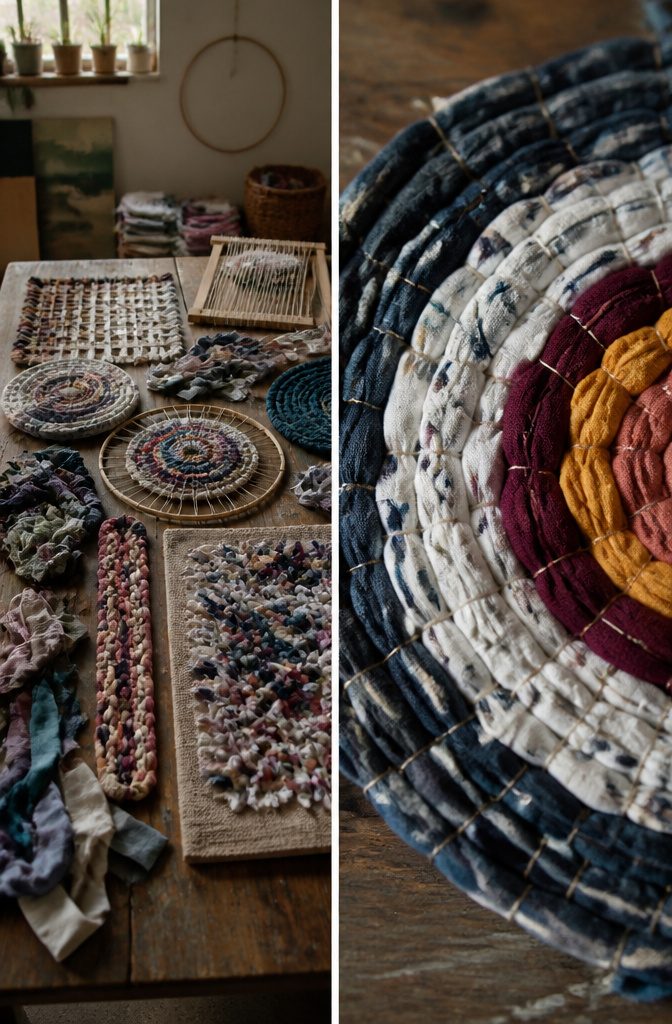
Socks are far from the only fabric you can turn into a rug.
Old T-shirts, bed sheets, worn towels, and stretched-out sweaters all work with the same general techniques, and most can handle socks just as easily if you want a slightly denser weave or a smaller finished size.
Here are the methods that show up most often:
- Braiding strips and coiling them flat into a spiral or oval, then stitching the coils together as you go
- Finger crochet, which needs no hook at all and works well once you cut your fabric into continuous yarn
- Weaving on a hula hoop frame, wrapping the hoop with a radial warp and then weaving strips around in a circle
- Looping fabric strips through a non-slip rug mat base, knotting each strip to hold it in place
- Cutting fabric into uniform pieces and gluing them to a canvas or rubber backing, closest to a shag finish
- Traditional flat weaving on a frame loom if you have one
- Knotting strips onto a mesh grid, similar to latch-hook rugs
- Sewing concentric rings of fabric tubes side by side for a coiled look
- Tying fabric scraps into a fringe on a woven or net base
All nine adapt to whatever scraps you have on hand, and none requires more than basic sewing or tying skill.
Frequently Asked Questions
How much fabric do you need for a rag rug?
For a small sock rug around 2 feet across, you need roughly 15 to 20 pairs of socks.
The exact count depends on how wide you cut your strips, how tightly you braid, and the size of the socks themselves. Larger socks stretch the count further, while smaller ones mean you’ll need more.
What are some ways to repurpose old socks?
Old socks can be cut into strips and braided into rugs, crocheted into mats, or woven on a hula hoop frame.
They work with the same techniques as T-shirts or sheets: finger crochet, looping through a rug mat base, or knotting onto a mesh grid.
Socks with worn heels or lost partners are ideal since they already sit unused in the drawer.